
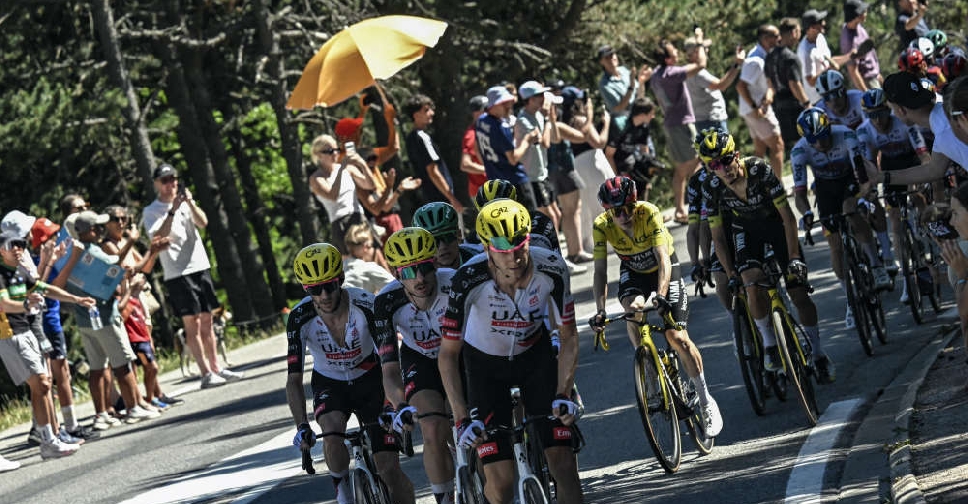
Tour de France riders are set to face scorching conditions as a new heatwave sweeps through the country, with temperatures around Carcassonne, where Tuesday's fourth stage begins, forecast to reach 41 degrees Celsius (106 Fahrenheit).
The demanding conditions are nothing new to the peloton, with extreme heat a frequent adversary in the Tour in July and in the Vuelta a Espana in August.
"We race the Tour de France in July, so it has always been hot and it always will be," French rider Hugo Page told reporters. "With global warming, things might just get worse and worse."
High temperatures could affect riders' health and safety, according to France's Benjamin Thomas of Cofidis.
"It can take its toll and really affect the riders’ health. Once the perceived temperature goes above 40 C, it really starts to get dangerous," he said.
Teams have introduced protocols to cool riders down before, during and after the stage, with ice vests, ice socks, ice cubes around the neck and ice slush being employed to lower core body temperatures.
"During the race, we use cold bottles," Cofidis head of performance Mattia Michelusi told Reuters, adding that his team also use special wristbands to help cool the body.
Netcompany-Ineos riders could be seen dipping their forearms into a basin of cold water on Saturday, imitating an aerodynamic position as they did so.
Groupama-FDJ United's medical director Mathieu Le Strat said the riders had heightened heat tolerance due to their targeted training.
"You can’t compare them to the general population, given the intensive heat training they’ve undergone," he said.
START STAGES EARLIER?
The objective of this training method is to help riders adapt to the heat.
"The first step is to get the rider used to this temperature," Michelusi explained. "This is the reason why we organize our training camp in Sierra Nevada, where you can get altitude and really high temperatures."
Nonetheless, prolonged exposure to extreme temperatures has already taken a toll, with dizziness and headaches reported during last month's French championships. Riders union CPA's vice president Pascal Chanteur urged the organisers to start stages earlier to avoid the hottest parts of the day.
"Working for six hours in extreme temperatures is simply not possible," Chanteur told Reuters. "The real solution for the future is to change the departure times. There’s no other option," he said.
But TV schedules that prioritise peak viewership pose a major obstacle for such adjustments.
Speaking before the Tour's departure in Barcelona on Saturday, race director Christian Prudhomme expressed confidence in the event's ability to deal with extreme weather.
"We are ready to adapt anywhere, anytime, all the time," Prudhomme told reporters on Friday.
"We will provide more ice to the teams. We can also allow the feed zones more often, and we already added a third motorbike to give more water bottles to the riders during the stage."
The International Cycling Union (UCI) introduced a High Temperature Protocol in 2024 using a five-tier risk assessment system based on the Wet Bulb Globe Temperature (WBGT), a system for measuring the impact on the body of direct sunlight, ambient temperature, humidity and wind.
The UCI's protocol, however, is not binding but only suggests countermeasures, with possible stage neutralisations or cancellations if the WBGT exceeds 28 C.
Furthermore, French regional officials have been given permission to cancel Tour de France stages if a red heatwave alert is issued, according to a French Interior Ministry document seen by Reuters last week.

 Dubai Basketball edge Real Madrid in EuroLeague opener
 Late Gakpo equaliser earns Dutch draw against Germany
 UAE launch Gulf Cup campaign with emphatic win
 HotelPlanner tour: Emirati talent on show at Abu Dhabi Challenge
 Joshua and Fury to face off in Cardiff in December