

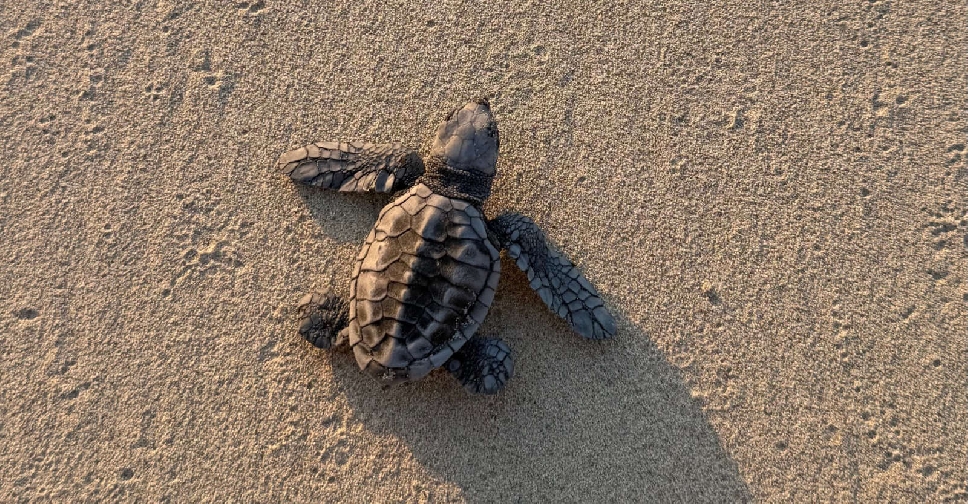
The Environment Agency – Abu Dhabi (EAD) has recorded the first-ever nesting of an Olive Ridley turtle in the emirate, marking a significant milestone for marine biodiversity in Abu Dhabi.
Discovered on Saadiyat Island, the nest represents a rare and exceptional occurrence.
Abu Dhabi's mainland coast and offshore islands are primarily recognised as nesting grounds for Hawksbill turtles, with the first confirmed Green turtle nest recorded as recently as 2023.
The Olive Ridley (Lepidochelys olivacea) nesting represents a further remarkable discovery and confirms them as the third nesting marine turtle species in the emirate's waters.
The species was confirmed through DNA barcoding undertaken in partnership with Khalifa University.
"That Abu Dhabi's waters continue to offer sanctuary to globally vulnerable species is a powerful reflection of what sustained, multi-front conservation efforts can achieve, and of the resilience we are building for both people and wildlife in a rapidly changing climate," said Dr. Shaikha Salem Al Dhaheri, Secretary General of the Environment Agency – Abu Dhabi (EAD).
The nest was discovered during a routine monitoring patrol by volunteers from EAD's Saadiyat Turtle Patrol, who monitored it closely throughout the incubation period.
Tracking the nest via a solar-powered camera and supported by EAD's marine specialists, the volunteers intensified their patrols as the expected hatching date approached, returning every morning and through the night to supervise the emergence of the hatchlings.
The turtle nested on March 29, 2026, laying 109 eggs. Hatchlings emerged on May 25, 2026, with 40 successfully reaching the sea, representing a hatching success rate of about 37 per cent.
As the first recorded Olive Ridley nesting in Abu Dhabi and an occurrence at the edge of the species' known nesting range, some variability in reproductive outcome is to be expected.
The successful emergence confirms that local conditions were sufficient to support the completion of the full reproductive cycle and provides an important baseline for future monitoring and conservation planning.
As Olive Ridley turtles have never previously been recorded nesting in Abu Dhabi, EAD partnered with Khalifa University to confirm the identification through DNA barcoding.
The technique compares short, standardised genetic sequences against international reference databases, enabling scientists to distinguish species with a high degree of confidence.
The analysis confirmed a 99 per cent genetic match to Lepidochelys olivacea, providing robust scientific confirmation of the discovery.
Olive Ridley turtles are recognised internationally as indicator species, meaning their presence reflects the overall condition of the marine ecosystems they inhabit.
As ecosystem engineers, they play an important role in maintaining healthy coastal environments. Feeding on invertebrates such as jellyfish, crabs, shrimp and molluscs, they help maintain balance within the marine food web and support the health of coral reefs and seagrass habitats.
Their nesting activity also transfers nutrients from the marine environment to coastal ecosystems, supporting beach vegetation and contributing to natural shoreline stability.
Listed as Vulnerable on the IUCN Red List of Threatened Species, Olive Ridley turtles nest at relatively few locations worldwide.
Every confirmed nest therefore carries international conservation significance while contributing to scientific understanding of the species' distribution and breeding behaviour.
The discovery builds on more than 25 years of marine turtle research by EAD.
Four of the world's seven marine turtle species have been recorded in the emirate: Hawksbill, Green, Loggerhead and Olive Ridley.
Hawksbill turtles are the predominant nesting species, with Green and Olive Ridley nesting representing rare but significant records, while Loggerhead turtles remain occasional visitors.
According to EAD's latest aerial survey, conducted in 2024, Abu Dhabi's waters support a marine turtle population of about 8,000 individuals, while nesting surveys have confirmed at least 17 nesting locations on offshore islands.

 Two convicted in Al Ain for assaulting a petrol station employee
 National University of Dubai appoints inaugural President
 UAE takes action over social media post insulting Emirati women
 Sheikh Abdullah congratulates Colombian FM on appointment
 Discover Abu Dhabi Festival takes Emirati culture to Moscow