

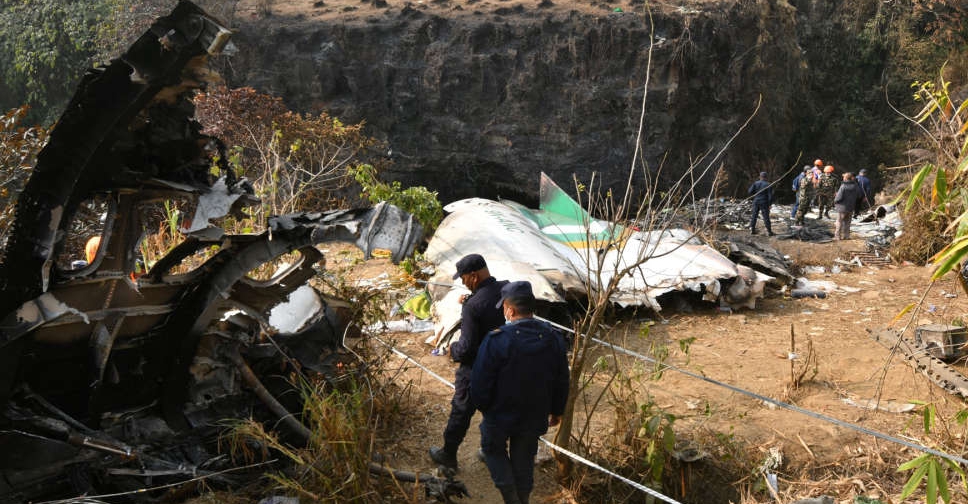
A Yeti Airlines crash in Nepal that killed 72 people almost a year ago was caused by the pilots mistakenly cutting power, leading to an aerodynamic stall, a report issued by a government-appointed investigation panel said.
The ATR 72, operated by privately owned Yeti Airlines, crashed just before landing in the tourist city of Pokhara on January 15 in one of Nepal's worst aeroplane accidents in 30 years.
There were 72 people on the twin-engine aircraft including two infants, four crew and 15 foreign nationals. There were no survivors.
Dipak Prasad Bastola, an aeronautical engineer and a member of the investigating panel, said due to lack of awareness and lack of standard operating procedures, the pilots had put the condition levers, which control power, in the feathering position, instead of selecting the flap lever.
This led the engine to "run idle and not produce thrust", Bastola told Reuters. "But due to its momentum, the aircraft flew for up to 49 seconds before hitting the ground.”
ATR is based in France and the plane's engines were manufactured in Canada by Pratt & Whitney.
It was Nepal's deadliest air crash since 1992, when a Pakistan International Airlines Airbus A300 crashed into a hillside on approach to Kathmandu, killing all 167 people on board.
Nearly 350 people have died since 2000 in plane or helicopter crashes in Nepal - home to eight of the world's 14 highest mountains, including Everest - where sudden weather changes can cause hazardous conditions.
The European Union has banned Nepali airlines from its airspace since 2013, citing safety concerns.


 Iran calls US peace proposals 'unrealistic', Trump issues new warning to Tehran
 Israel passes death penalty law for Palestinians convicted of lethal attacks
 France seeks emergency UN meeting after Lebanon peacekeeper attacks
 At least 70 killed in Haiti massacre, rights group says
 Spain closes airspace to US planes involved in Iran war, defence minister says