

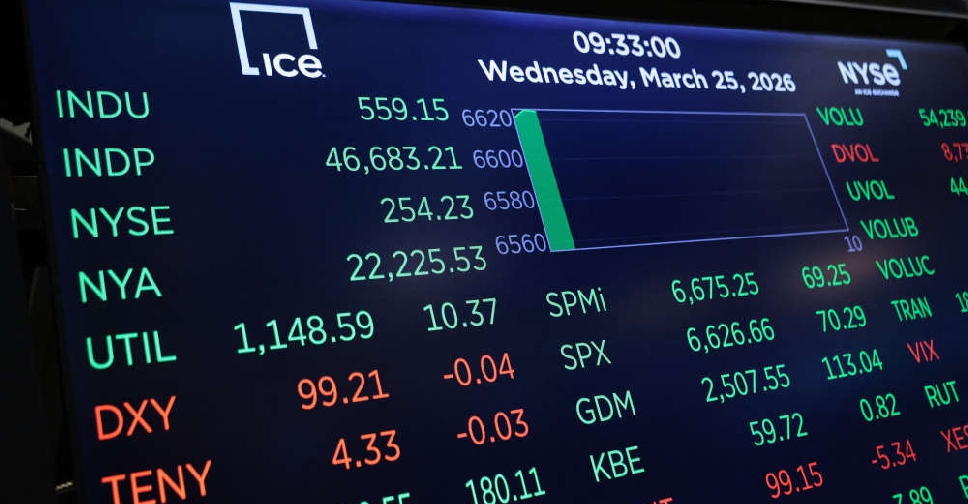
Global equity markets, including from the U.S., Europe and Asia, rose while oil prices fell on Wednesday, as traders cheered news of ceasefire proposals to de-escalate the ongoing conflict in the Middle East.
Markets are weighing reports that the U.S. has sent a 15-point ceasefire proposal to Iran that was reportedly delivered via Pakistan. An Iranian official said Tehran has received the proposal but considers its conditions excessive, adding that the country will end the war only at a time of its own choosing and if its conditions are met.
On Wall Street, the Dow Jones Industrial Average .DJI rose 0.92%, the S&P 500 .SPX rose 0.89% and the Nasdaq Composite .IXIC rose 1.29%.
In Europe, the STOXX 600 .STOXX index rose 1.34%. London's FTSE 100 .FTSE was up 1.17%.
MSCI's gauge of stocks across the globe .MIWD00000PUS rose 1.21%.
Overnight in Asia, MSCI's broadest index of Asia-Pacific shares outside Japan .MIAPJ0000PUS closed higher by 1.82%.
"The mood is on the positive side," said Amelie Derambure, senior multi-asset manager at Amundi. "(The) market is trading now the idea that peace talks or a ceasefire could be on the way."
Derambure said traders were positioning themselves to avoid missing out on a possible "relief rally," when markets rise on positive news, although she added that more convincing news will be needed for the move to be sustained.
A senior Iranian official told Reuters that Pakistan had delivered the U.S. proposal to Iran, and that either Pakistan or Turkey could be venues for discussions about de-escalating the war.
BOND YIELDS FALL
Oil prices, which have risen sharply since the joint U.S.-Israeli strikes on Iran, eased slightly. Brent crude futures LCOc1 were down 3.9% at $100.42 a barrel while U.S. West Texas Intermediate crude futures CLc1 down 3.8% at $88.86 a barrel.
Iran has said that "non-hostile vessels" may cross the Strait of Hormuz if they coordinate with Iranian authorities, but the waterway, which typically carries about one-fifth of the world's gas and crude supply, remains effectively closed.
U.S. bond yields were lower across the board. The yield on benchmark U.S. 10-year notes US10YT=RR fell 7 basis points to 4.324%.
European government bond yields also fell, in a move led by Italian bonds, which had been particularly hard-hit since the war started due to Italy's dependence on fossil fuel imports.
The benchmark 10-year German yield fell 5.1 basis points to 2.964% DE10YT=RR.
In currencies, the U.S. dollar gained against its peers including the Japanese yen, Swiss franc and the euro.
The euro was down by 0.32% at $1.1569 EUR=. The Japanese yen JPY= weakened 0.21% against the greenback to 159.04 per dollar. The Swiss franc CHF= was down 0.27% to 0.79 against the dollar.
The dollar index =USD, which measures the greenback against a basket of currencies including the yen and the euro, rose 0.21% to 99.40.
Gold prices roseXAU=, as falling oil prices eased some of the concerns about inflation. Spot gold XAU= rose 2.05% to $4,565.41 an ounce.

 Australia moves to double fines for fuel gouging amid shortages
 Gulf stocks mixed amid confusion over US-Iran talks
 Australia, EU seal long-awaited trade deal
 Weaponising Strait of Hormuz is an act of economic terrorism: Sultan Al Jaber
 IEA consulting with governments on further oil stock releases, chief Birol says