
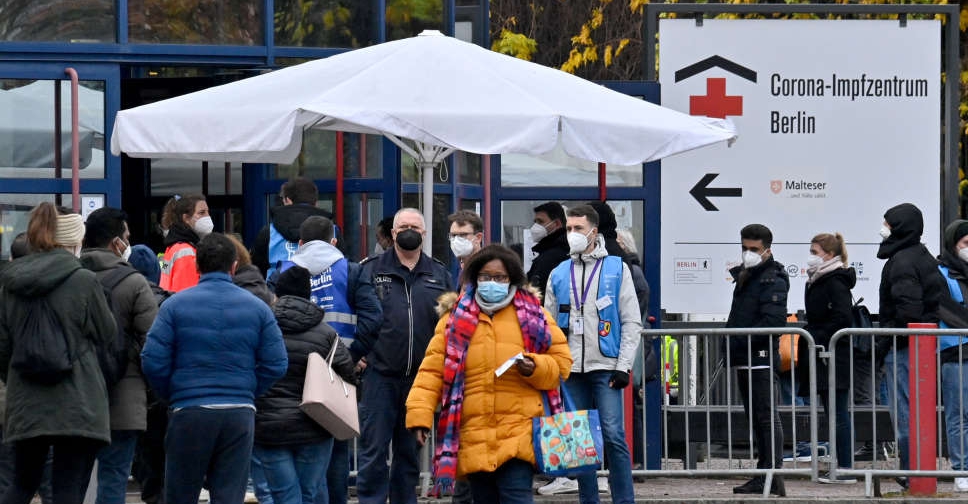
Germany and Italy detected cases of the new Omicron coronavirus variant, with more nations imposing restrictions on travel from southern Africa.
The discovery of the variant has sparked global concern, a wave of travel bans or curbs and a sell-off on financial markets on Friday as investors worried that Omicron could stall a global recovery from the nearly two-year pandemic.
The health ministry in the German state of Bavaria announced two confirmed cases of the variant. The two people entered Germany at Munich airport on November 24, before Germany designated South Africa as a virus-variant area, and were now isolating, said the ministry, indicating without stating explicitly that the people had travelled from South Africa.
In Italy, the National Health Institute said a case of the new variant had been detected in Milan in a person coming from Mozambique.
Czech health authorities also said they were examining a suspected case of the variant in a person who spent time in Namibia.
Omicron, dubbed a "variant of concern" by the World Health Organisation, is potentially more contagious than previous variants of the disease, although experts do not know yet if it will cause more or less severe COVID-19 compared to other strains.
Israel said it would ban the entry of all foreigners into the country and reintroduce counter-terrorism phone-tracking technology to contain the spread of the variant.
The variant was first discovered in South Africa and had also since been detected in Belgium, Botswana, Israel and Hong Kong.
FLIGHTS TO AMSTERDAM
Dutch authorities said 61 of around 600 people who arrived in Amsterdam on two flights from South Africa on Friday had tested positive for the coronavirus. Health authorities were carrying out further tests to see if those cases involved the new variant.
One passenger who arrived from South Africa on Friday, Dutch photographer Paula Zimmerman, said she tested negative but was anxious for the days to come.
"I’ve been told that they expect that a lot more people will test positive after five days. It's a little scary the idea that you’ve been in a plane with a lot of people who tested positive," she said.
It could take weeks for scientists to understand fully the variant's mutations and whether existing vaccines and treatments are effective against it.
TRAVEL CURBS
Although epidemiologists say travel curbs may be too late to stop Omicron from circulating globally, many countries around the world - including the United States, Brazil, Canada and European Union nations - announced travel bans or restrictions on southern Africa on Friday.
The US Centers for Disease Control and Prevention (CDC) and State Department added on Saturday to Washington's previously announced travel restrictions, advising against travel to eight southern African countries.
US Vice President Kamala Harris told reporters on Saturday that the administration will take it "one step at a time," when asked about additional travel restrictions. "For now we've done what we think is necessary," Harris said.
Also on Saturday, Australia said it would ban non-citizens who have been in nine southern African countries from entering and will require supervised 14-day quarantines for Australian citizens returning from there.
Japan and Britain said they were extending travel curbs to more African countries, while South Korea, Sri Lanka, Thailand, Oman, Kuwait and Hungary announced new travel restrictions.
South Africa is worried that the curbs will hurt tourism and other sectors of its economy, the foreign ministry said on Saturday, adding the government is engaging with countries that have imposed travel bans to persuade them to reconsider.
Omicron has emerged as many countries in Europe are already battling a surge in COVID-19 infections, and some have re-introduced restrictions on social activity to try to stop the spread. Austria and Slovakia have entered lockdowns.
VACCINATIONS
The new variant has also thrown a spotlight on disparities in how far the world's population is vaccinated. Even as many developed countries are giving third-dose boosters, less than 7 per cent of people in low-income countries have received their first COVID-19 shot, according to medical and human rights groups.
Seth Berkley, CEO of the GAVI Vaccine Alliance that with the WHO co-leads the COVAX initiative to push for equitable distribution of vaccines, said this was essential to ward off the emergence of more coronavirus variants.
“While we still need to know more about Omicron, we do know that as long as large portions of the world’s population are unvaccinated, variants will continue to appear, and the pandemic will continue to be prolonged," he said in a statement to Reuters.
"We will only prevent variants from emerging if we are able to protect all of the world’s population, not just the wealthy parts."


 Thai teen kills 7 in rampage at home and school before shooting himself
 Syria says bomb on minibus near Damascus wounded 14, deaths reported mistakenly
 Morocco to cooperate on return of minors from Spain after Ceuta crossing
 North Korea fires short-range ballistic missile, South Korea says
 Wildfire prompts evacuation alert in metro Vancouver